DAY 2 – FRIDAY 21ST AUGUST, 2026
MILAN SAN REMO RIDE
Ride Distance: 45km Climbing: 650m
Meals: Breakfast
Timeline
7:00 – 8:00am Breakfast
8:00am Depart Menton Hotel in Vehicle for Sanremo. Approx 1 hour
10am: Our Ride Starts from Sanremo
More about our day
This morning after breakfast we depart our hotel and transfer to Sanremo [approx. 1 hour transfer]. Upon arrival we’ll unload our bikes and get ready to take on the final route of Milan – San Remo taking in the famous climbs of Cipressa and Poggio
Today’s ride.
Our Ride: 45km
Climbing: 650m
Today we preview the final sections of the Milan – Sanremo course. From Sanremo we follow the coastal roads and bikeway south for approx. 18km. Once we reach the small town of San Lorenzo al Mare, we swing around and commence on today racecourse, we ride onto the Cipressa and then onto the Poggio The famous Poggio is a great little climb situated in the Liguria region of Italy, above the coastal roads, and comes around 20 km before the finish line of the Milan – Sanremo race. While not the most challenging climb on the Milan San Remo route, it still tests the riders with its steady gradient and its placement at nearly 270km into the race when fatigue sets in. On our ride today, after descending the Poggio we make our way back to our hotel to check in, shower and change quickly then head out to see the race finish’s.
Suggested post-ride rehydration
The Spritz is a popular Italian aperitif cocktail that originated in the Veneto region, particularly in the city of Venice and it’s now spreading all over the world. It’s known for its refreshing and bittersweet flavoured profile, making it a beloved choice for pre-dinner drinks or social gatherings. The three main ingredients are Prosecco, Aperol or Campari and soda water. Traditionally, the Spritz is served over ice in a wine glass or a tumbler, garnished with a slice of orange or sometimes an olive, depending on regional variations and personal preference.
Women’s Sanremo Race: 156km
The first edition of the Sanremo Women starts from Genoa, passes the Porto Antico on an elevated road until it reaches Sestri Ponente and enters the Aurelia state road. A few kilometers later, the professional race meets in Voltri and from there the race continues to the finish line, retracing the road that for more than 110 years has connected Milan to Sanremo. It then continues westward next to the sea along the Aurelia state road through Varazze, Savona, Albenga until it reaches Imperia. In San Lorenzo al Mare, after the classic sequence of the Tre Capi (Mele, Cervo and Berta), the two climbs inserted in recent decades are tackled: Cipressa (1982) and Poggio di Sanremo (1961). The Cipressa exceeds 5.6 km at 4.1% to enter the very technical descent that takes you back to the ss.1 Aurelia. Final kms 9 km from the finish line, the climb of Poggio di Sanremo begins (3.7 km at less than 4% on average with peaks of 8% in the section preceding the summit). The climb has a slightly narrow carriageway and 4 hairpin bends in the first 2 km. The descent is very challenging on an asphalt road, narrow in some sections, with a succession of hairpin bends and curves and counter-curves until the junction with the Aurelia state road. The last part of the descent takes place in the town of Sanremo. The last 2 km are on long straights on city streets. Noteworthy is a left-hand bend on a roundabout 850 m from the finish line and the last bend 750 m from the finish line that leads onto the final straight of Via Roma, all on asphalt.
Men’s Milan – San Remo race 289km
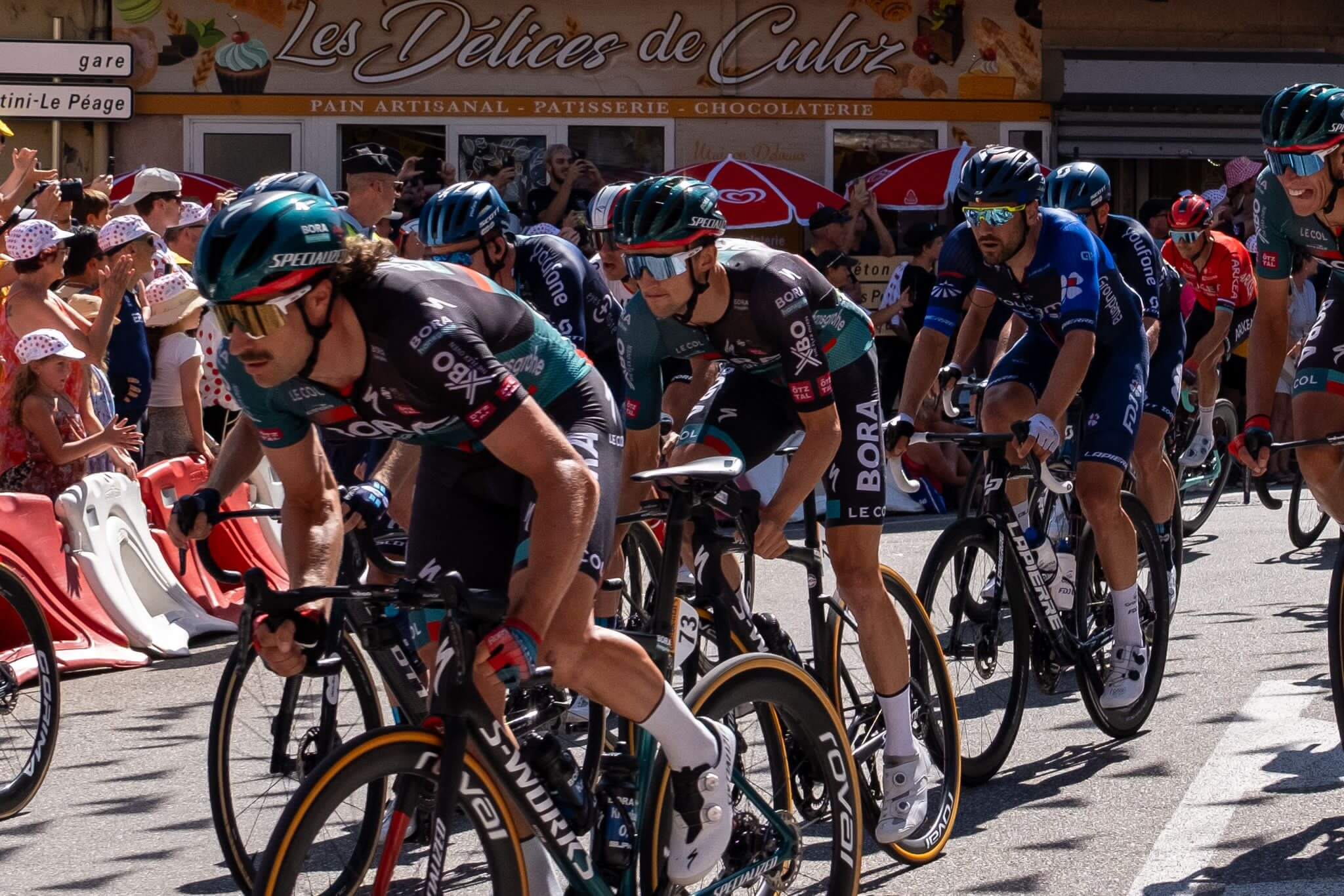
The most successful rider with seven victories is Belgian Eddy Merckx. Italian Costante Girardengo achieved 11 podium finishes in the interwar period, winning the race six times. In modern times, German Erik Zabel and Spaniard Óscar Freire have recorded four and three wins respectively. Milan–San Remo is considered a sprinters classic because of its mainly flat course, although the Poggio climb close to the finish has often been an opportunity for puncheurs and rouleurs.
The 2026 Milano-Sanremo starts in Pavia, heads north towards Milan—the historic start location of the race—and reaches the Certosa, where it merges back onto the traditional course. The route touches Casteggio and Voghera, Rivanazzano and Salice Terme, and then goes back onto the traditional course in Tortona.
From there, the race follows it all the way to the finish, along the route that has connected Milan to the Riviera di Ponente for over 110 years, through Ovada and the Passo del Turchino, dropping into Genoa in Voltri. From there, it continues westwards, by the sea, following the Statale Aurelia through Varazze, Savona, Albenga (avoiding the Manie climb, which only featured in the route from 2008 to 2013) and Imperia. In San Lorenzo al Mare, past the classic sequence of the Tre Capi (Mele, Cervo and Berta), the peloton will negotiate the two climbs that have entered the race route in recent decades: the Cipressa (1982) and the Poggio di Sanremo (1961). The Cipressa is 5.6 km long with a gradient of 4.1%. The highly testing descent leads back down to SS 1 Aurelia. The ascent of Poggio di Sanremo begins with 9 km remaining to the finish (3.7 km, average gradient less than 4%, maximum 8% in the segment before getting to the top of the climb). The road is slightly narrower, with 4 hairpin turns in the first 2 km. The descent is testing, on asphalt switchback roads, narrow at points and with twists and turns as far as the junction with SS 1 Aurelia. The final part of the descent enters urban Sanremo. The last 2 km are on long, straight urban roads. There is a left-hand bend on a roundabout 850 m from the finish line. The last bend, leading into the tarmac home straight on the Via Roma, is 750 m from the finish line
More About Sanremo
Lying along the sun-drenched Riviera dei Fiori, Sanremo has a mild and pleasant micro‑climate, as compared to other cities of the region, which makes it the perfect tourist destination. It is renowned for flower farming (hence its nickname, ‘the city of flowers’) and for a traditional parade of flower-covered floats held every year in the spring, called ‘Sanremo in fiore’.
Other famous events taking place in Sanremo every year include the Italian Song Festival, aired by the national broadcaster Rai, and the Rassegna della canzone d’autore, organised by the Club Tenco. The old town centre (nicknamed La Pigna, ‘the pine cone’, after the shape of its ancient defensive walls) reflects the glorious past of the city. Main sights include the Basilica Collegiata Cattedrale di San Siro, the sanctuary of Madonna della Costa, the hermitage of San Michele, and the Church of Cristo Salvatore, built in the late 19th century by the Russian nobility, nowadays one of the symbols of the town, together with the Casino, nearby, one of the three remaining in Italy. Notable sights also include many private mansions built along the promenade: Palazzo Bellevue (which has been a luxury hotel for many years, and became the city hall in 1963); Palazzo Borea d’Olmo (one of the major Baroque buildings of western Liguria, a few metres away from Teatro Ariston); Villa Ormond (renowned for its park, with many exotic plants); Villa Nobel (built in Moorish style, the last place where Alfred Nobel lived, currently a museum and a venue for cultural meetings), Villa King, nearby (Art Deco), and Castello Devachan (the venue of the meeting of the victorious Allies after the end of World War I in 1920).
Speaking of sports, the city is renowned as the finish of MilanoSanremo and it has been the venue of an iconic automobile rally since 1928.
Tonight’s Soiree
Free program. We’ve kept this evening as free program to encourage exploring Avignon, it’s a great chance to indulge in some cultural immersion via food, wine and its bars, Restaurants, and Cafés.
Accommodation:
French/Italian Rivier
4* Chic, Cycling Friendly Hotel


 Nice, France
 Our combined experience in Spain and France allows us to put a superb series of rides and experiences together through quaint villages, small roads, laneways and see lovely historic places of interest in this north eastern region.